
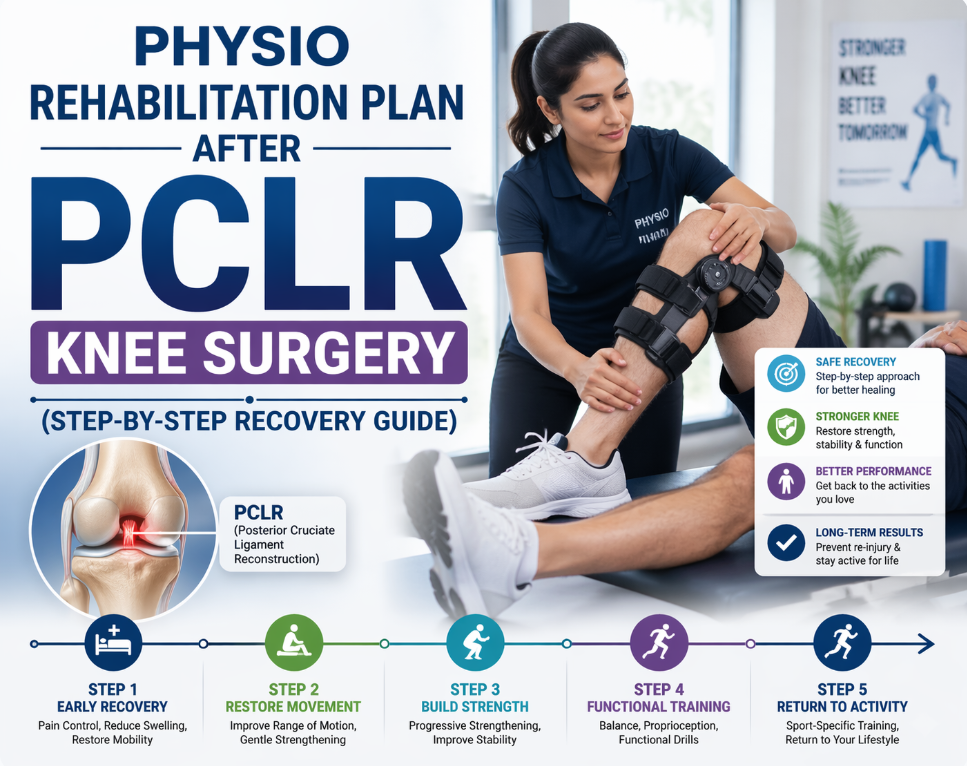
PCLR rehab isn’t just another routine after knee surgery—it’s a phase-by-phase plan that helps in on rebuilding knee stability and strength in normal way. PCL rehab is not so much different as ACL Rehab Physio rehabilitation but if you to do physiotherapy after PCLR surgery, you need to be extra careful about protecting the back of your knee. That PCL graft after the PCLR surgery needs time without any extra stress.
Unlike other knee ligament injuries, PCL rehabilitation requires special care to avoid placing excessive stress on the healing graft. This guide outlines a complete, phase-wise recovery plan along with expert tips to ensure optimal healing.
What is PCLR Surgery ?
PCLR (Posterior Cruciate Ligament Reconstruction) is a surgical procedure performed in knee to repair a torn PCL, one of the key ligaments that stabilize the knee joint. The PCL prevents the tibia (shin bone) from moving backward relative to the femur (thigh bone).
After surgery, physiotherapy plays a critical role in regaining mobility, preventing stiffness, and rebuilding muscle strength.
What is PCLR Rehabilitation Protocol?
Physio rehabilitation after PCLR knee surgery is essential for restoring knee stability, strength, and full function. A well-structured posterior cruciate ligament (PCL) rehab protocol focuses on protecting the healing graft while gradually improving mobility and muscle control.
Immidiate after surgery of this PCL ligament, the physiotherapy has to be started as soon as possible. The Phyiso rehab protocoal has to be planned well so that the knee become normal working according to the time.
The best results after PCL surgery come from sticking with the definite plan, getting supervision with knee surgeon or orthopedic surgeon and experienced physiotherapist when you can, and making sure it fits your needs. Always need to know that the Consistency matters as well as the good technique and dedication.. And honestly, it’s crucial not to push too soon—give your knee the time it deserves.
Why Physiotherapy is Important After PCLR Surgery ?
A structured PCL rehab protocol helps:
- Restore knee range of motion (ROM)
- Strengthen associated muscles (quadriceps, glutes, calf)
- Improve balance and coordination
- Prevent complications like joint stiffness or instability
- Reduce the risk of re-injury
- return to normal life soon
Consistency in the physio rehabilitation is one of the most important factors for successful recovery from it.
PCL Rehab Timeline Overview
| Phase | Duration | Focus |
|---|---|---|
| Early Phase | 0–4 weeks | Protection & activation |
| Intermediate | 4–12 weeks | Strength & mobility |
| Strength Phase | 3–6 months | Stability & function |
| Advanced | 6–9 months | Agility & coordination |
| Return to Sport | 9+ months | Full recovery |
Phase-Wise Physio Rehabilitation Plan After PCLR Knee Surgery
After PCLR surgery, healing to normal can be divided to 4 phases(Phase 1( to Phase 5) from early recovary to Normal .
Let know the Physio Rehabilitation Plan as per the recovery phase and plan the rehabilitation as following for good and faster recovery with goals with key guidelines and recommended exercises.
Phase 1: Early Recovery (0–4 Weeks)
Goals:
- Reduce pain and swelling
- Protect the surgical graft
- Restore full knee extension
- Activate quadriceps muscles
Key Guidelines:
- Use a knee brace as prescribed
- Limit knee bending (flexion)
- Avoid hamstring activation
Recommended Exercises:
- Quadriceps sets
- Straight leg raises
- Ankle pumps
- Gentle passive range of motion exercises
During this early phase, you have to focus is on healing and preventing complications rather than aggressive movement. Aggressive movement is not done at this stage. If pain aggravates or any unusual happen then need to stop for time being.
Phase 2: Intermediate Phase (4–12 Weeks)
Goals:
- Improve knee flexion gradually
- Begin controlled weight-bearing
- Build basic strength
Key Guidelines:
- Avoid deep squats
- Delay hamstring strengthening initially
- Progress slowly
Recommended Exercises:
- Mini squats
- Step-ups (low height)
- Stationary cycling (low resistance)
- Balance exercises
In this intermediate phage, focuses on rebuilding strength while still protecting the ligament.
Phase 3: Strengthening Phase (3–6 Months)
Goals:
- Increase muscle strength
- Improve joint stability
- Enhance functional movement
Recommended Exercises:
- Lunges
- Leg press (controlled range)
- Glute bridges
- Core strengthening
- Proprioception and balance drills
At this stage, patients start regain confidence in movement of limbs and begin more functional activities.
Phase 4: Advanced Training (6–9 Months)
Goals:
- Prepare for return to activity
- Improve coordination and agility
- Restore full functional capacity
Recommended Exercises:
- Light jogging
- Agility drills
- Plyometric exercises (jump training)
- Direction-change drills
Progression depends on strength, stability, and absence of pain or swelling.
Phase 5: Return to Sport (9+ Months)
Goals:
- Safe return to sports
- Prevent re-injury
- Achieve full performance level
Criteria for Return:
- Strength symmetry between both legs
- Good balance and control
- No pain or swelling
- Clearance from physiotherapist or surgeon
Exercises to Avoid After PCLR Surgery
To protect the healing ligament, avoid:
- Early hamstring strengthening
- Deep squats (early phase)
- Running too soon
- Sudden pivoting or twisting movements
These activities can place excessive stress on the PCL graft and delay recovery.
Tips for Faster Recovery After PCL Reconstruction
- Follow your physiotherapist’s plan strictly
- Avoid skipping rehabilitation phases
- Maintain consistency in exercises
- Use proper technique during workouts
- Rest adequately to allow healing
- Monitor swelling and pain levels
Recovery is gradual, and pushing too fast can increase the risk of complications.
Common Challenges During PCL Rehab
Patients may experience:
- Knee stiffness
- Muscle weakness
- Fear of movement
- Delayed progress
These challenges are normal and can be managed with proper guidance and patience.
FAQs: PCLR Rehabilitation
How long does PCLR rehab take?
Recovery typically takes 6 to 9 months, but full return to sports may take up to 12 months depending on individual progress.
When can I walk after PCL surgery?
Walking with support usually begins within a few weeks, depending on your surgeon’s protocol.
Can I do home-based rehab after PCLR?
Yes, many exercises can be done at home, but regular guidance from a physiotherapist is recommended.
Is PCL rehab different from ACL rehab?
Yes, PCL rehab focuses more on protecting the posterior knee and delaying hamstring exercises.
Conclusion
A well-structured physio rehabilitation plan after PCLR knee surgery is essential for a safe and successful recovery. By following a phase-wise protocol, staying consistent, and avoiding early overload, patients can regain strength, stability, and confidence in their knee.
Whether your goal is returning to sports or simply resuming daily activities, proper physiotherapy is the key to long-term success after PCL reconstruction.



More Stories
Stroke Physiotherapy Protocol in Nepal (Recovery Guide in Kathmandu)
Knee Pain Treatment and Rehabilitation Guide: Expert Tips for Fast Recovery
Home-Based ACL Rehab Plan in Nepal